************************************************************
Winter
BY
EXTENSION
HORTICULTURIST
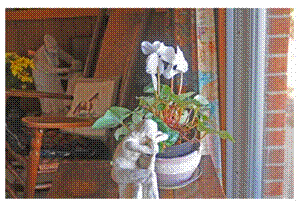 During the short days of winter, houseplant growth slows,
resulting in a need to change how we care for them. Although frequent
watering may have been necessary during the long days of summer, the
same amount now could cause problems. Excess water fills air spaces
within the soil resulting in roots that receive less oxygen than they
need. Water by touch, not by calendar. If the soil is dry an inch deep,
it is time to water. Be sure to add enough so that some water flows out
the bottom of the pot. This will help wash out excess salts that tend to
accumulate within the potting soil.
Fertilization also should be reduced. Normally, it is best to
apply half the amount of fertilizer for flowering houseplants and
one-fourth the amount for foliage houseplants. Too much fertilizer
results in plants that become leggy and weak.
During the short days of winter, houseplant growth slows,
resulting in a need to change how we care for them. Although frequent
watering may have been necessary during the long days of summer, the
same amount now could cause problems. Excess water fills air spaces
within the soil resulting in roots that receive less oxygen than they
need. Water by touch, not by calendar. If the soil is dry an inch deep,
it is time to water. Be sure to add enough so that some water flows out
the bottom of the pot. This will help wash out excess salts that tend to
accumulate within the potting soil.
Fertilization also should be reduced. Normally, it is best to
apply half the amount of fertilizer for flowering houseplants and
one-fourth the amount for foliage houseplants. Too much fertilizer
results in plants that become leggy and weak.
Location is another factor that should be considered this time of
year. Since day length is so short, houseplants may be helped by being
moved to areas of the room that receive more light, such as a south-or
east-facing window.
Avoid placing plants where drafts from doors or direct output
from heating ducts may contact them. Relative humidity also tends to be
low during the winter. If you do not have a humidifier, frequent misting
of the plants or placing them on water-filled trays of pebbles can help
raise the humidity. (Copyright by
(Source:
*************************************************************
Roasting
Pumpkin Seeds
BY
EXTENSION
HORTICULTURIST
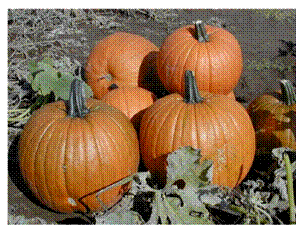 Now that Halloween is past, you may be wondering what to do with
the pumpkins that were used to decorate for the holiday. Consider
roasting the seeds before freezing temperatures destroys the pumpkin
fruit. Cut open the pumpkin and remove the seeds and stringy material.
Seeds should be washed and dried and the “strings” discarded.
Now that Halloween is past, you may be wondering what to do with
the pumpkins that were used to decorate for the holiday. Consider
roasting the seeds before freezing temperatures destroys the pumpkin
fruit. Cut open the pumpkin and remove the seeds and stringy material.
Seeds should be washed and dried and the “strings” discarded.
Toss the seeds with a little oil before roasting. Flavor can be
enhanced by adding a sprinkling of salt to the oiled seeds. Seeds can
then be spread on a cookie sheet and roasted for about 25 minutes at 325
degrees F. Times may vary depending on the size and moisture content of
the seed. Seeds are done when they turn a golden brown. If seeds are not
eaten immediately, store in a zip closure bag in the refrigerator.
(Copyright by
(Source:
*************************************************************
Can I add
wood ashes
to my flower
or
by
As I write this the temperature dropped all after
According to
Increasing the alkalinity (pH) of the soil does affect plant
nutrition. Nutrients are most readily available to plants when the soil
is slightly acidic. As soil alkalinity increases and the pH rises above
7.0, nutrients such as phosphorus, iron, boron, manganese, copper, zinc
and potassium become chemically tied to the soil and less available for
plant use.
Applying small amounts of wood ash to most soils will not
adversely affect garden crops, and the ash does help replenish some
nutrients. But because wood ash increases soil pH, adding large amounts
can do more harm than good. Keep in mind that wood ash that has been
exposed to the weather, particularly rainfall, has lost a lot of its
potency, including nutrients.”
(Source: http://lancaster.unl.edu/hort/articles/2007/woodash.shtml)
Therefore, small amounts
of no more than 1 inch will probably not hurt, if worked into the soil
at least 6 inches. But be sure and get a soil test before you add more
than that once per year as most of the soils in Eastern and South
Central Nebraska already are alkaline with a pH of 6.5 to 7.5. Do not
add significant amounts without having a soil test.
Copyright 2014